 Proudly British Owned & Operated

Commercial Roof Repair or Replacement — How to Decide
When a commercial roof starts causing problems, the first question is always the same: do we repair it or replace it? Get it wrong in either direction and it costs you. Patch a roof that needed replacing and you're back on site six months later spending more money. Replace a roof that had years of serviceable life left and you've written off a significant asset prematurely.
The honest answer is that there's no universal rule. It depends on the roof type, its age, the nature of the defects, and how many systems are failing simultaneously. What follows is a practical guide to the most common commercial roof types and the specific warning signs that indicate whether repair or replacement is the right call.
The starting point for any roof — regardless of type — should always be a professional condition survey. What looks like an isolated leak from the inside is often a symptom of multiple failing components on the outside.
A condition survey gives you an accurate picture of what you're actually dealing with before any money is committed.
What looks like an isolated leak from the inside is often a symptom of multiple failing components on the outside.
Metal Roofing — Repair or Replace?
Commercial metal roofs are durable, but they have a defined lifespan and a predictable set of failure points. Understanding which components are failing — and how many — is the key to making the right decision.
Box gutters are one of the most frequent sources of leaks on older metal roofed buildings. The joint areas where sections of box gutter meet are particularly vulnerable — sealants break down over time and water finds its way through. In isolation, box gutter repairs are straightforward and cost-effective.
Cut edges are another significant issue. The cut edges of metal sheets — where the sheet has been cut to length — are left exposed after installation. Over time, the powder-coated or plastisol finish weathers and retreats from the cut edge, leaving bare metal exposed to the elements. On roofs over 30 years old this is extremely common and, once started, accelerates quickly.
Rooflights are a consistent problem area, particularly around the end laps and side laps. Polycarbonate rooflights become brittle with age, cracking and fracturing in ways that GRP alternatives are more resistant to. Fixings on rooflights and on cladding elevations also work loose over time, creating gaps and allowing water ingress.
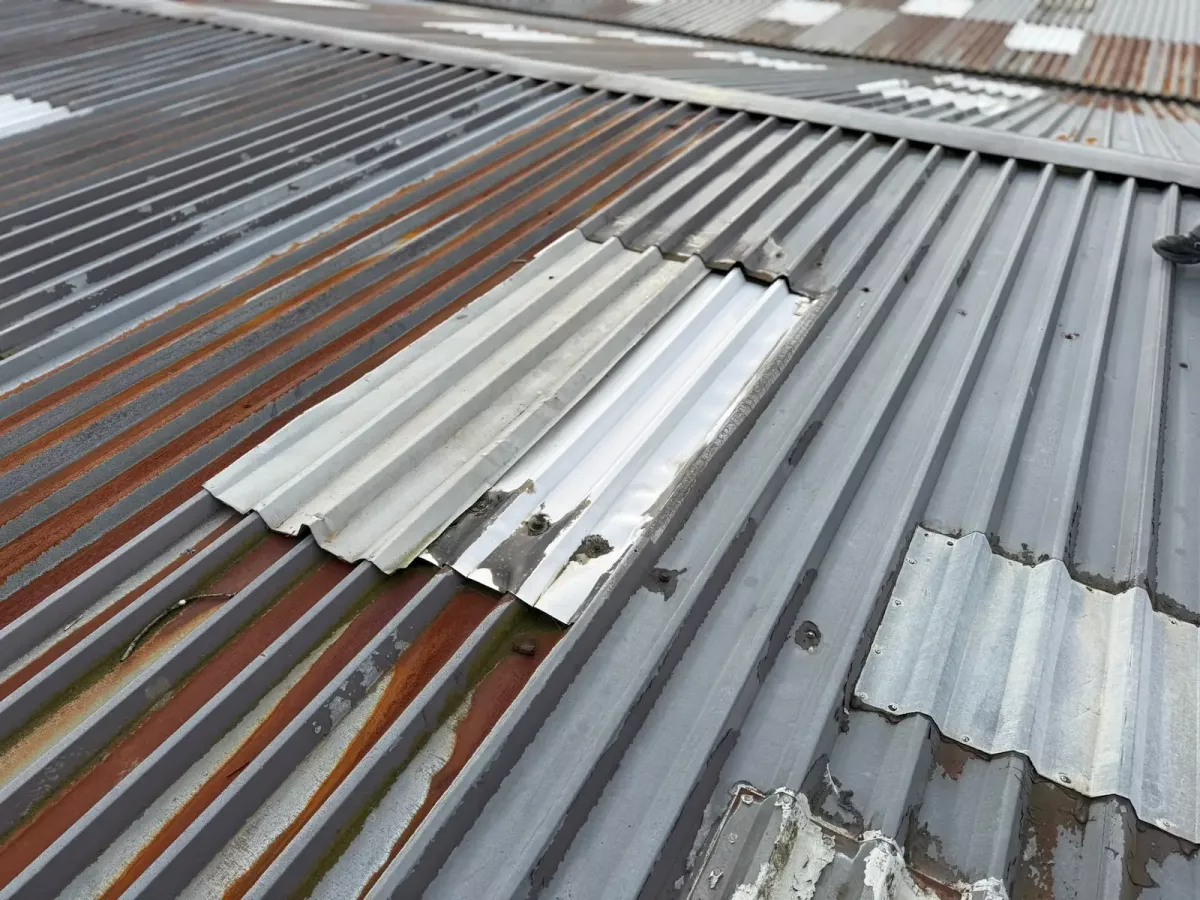
Flashings and details — the junction points where the roof meets walls, upstands and penetrations — are another common failure point, particularly on older installations where original sealants have long since failed.
When to repair a metal roof: if you have one or two isolated failure points — a box gutter joint, a handful of loose fixings, a single failed rooflight — repair is the right call. These are manageable, localised defects on a roof that is otherwise performing.
When to replace a metal roof: replacement becomes the correct decision when multiple systems are failing simultaneously, particularly when the protective coating on the metal sheets themselves has corroded away and bare steel is exposed. Once steel is exposed to the elements, corrosion accelerates significantly and no surface repair will arrest it permanently. At that point you are maintaining a failing asset rather than protecting a functioning one. A complete roof replacement is the more cost-effective long-term decision.
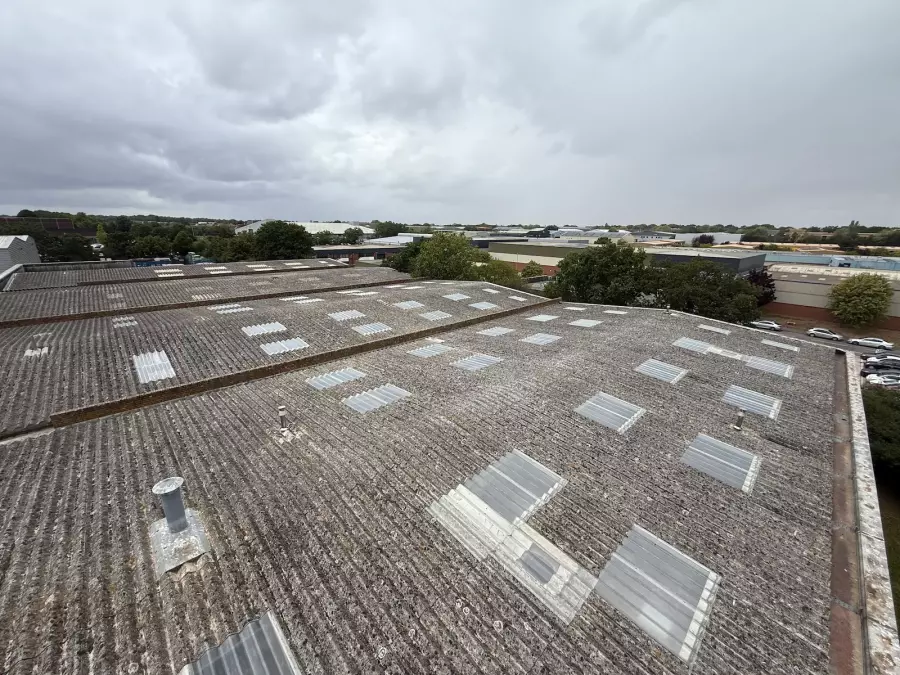
Asbestos Cement Roofing — Repair or Replace?
Many commercial and industrial buildings constructed before 2000 still have asbestos cement roofing in place. Managing these roofs requires careful consideration — both technically and from a compliance standpoint.
The most common source of leaks on asbestos cement roofs is cracking and splitting of the sheets themselves. This is largely caused by hook bolts — the fixings that hold the sheets to the purlins — loosening over time. As the bolts work loose, the sheets move slightly under wind loading, creating hairline fractures that allow water ingress. Once fractured, asbestos cement sheets cannot be conventionally repaired.
Box gutters on asbestos roofs fail in the same way as on metal roofs — joint areas and sealant deterioration being the primary causes.
Rooflights on older asbestos roofed buildings are almost always polycarbonate, and polycarbonate becomes extremely brittle with age. On a roof of 30 to 40 years, it is common to find rooflights that have cracked, fractured, or partially collapsed — representing both a water ingress and a safety risk.
Where sheet cracking is localised and the overall roof structure is sound, there are options short of full replacement. GRP overlay sheets can be installed over cracked areas to arrest leaks. Overcladding — installing a new roof system directly over the existing asbestos sheets — is another option that encapsulates the asbestos in place and avoids the cost and disruption of full removal.
When a significant proportion of the sheets are cracked, when rooflights are failing across the roof, and when box gutters are also deteriorating, the cumulative repair cost typically exceeds the cost of replacement. At that point, full removal and replacement — carried out by licensed asbestos contractors — is the right decision. It also removes the ongoing compliance and management burden of maintaining a building with asbestos cement in place.
Single Ply Membrane Roofing — Repair or Replace?
Single ply membrane systems — Sika, Soprema, IKO and others — are among the most durable flat roofing options available, with properly installed systems lasting 25 years or more. When they do fail, the failure points are usually predictable.
The most common issues are seam failures — where the heat-welded joints between membrane sheets have not been properly welded or have been disturbed. Perimeter details and upstands are another frequent failure point, as is damage around roof penetrations such as pipes and drainage outlets. Membrane punctures from foot traffic or falling debris also occur, though a well-specified membrane is highly resistant to mechanical damage.
Single ply membranes are generally very repairable. Seam failures, perimeter detail issues and punctures can all be addressed with targeted repairs by an approved contractor using compatible materials. If the membrane itself is in good overall condition and failures are isolated, repair is almost always the right call.
If the membrane has reached the end of its serviceable life — typically indicated by widespread crazing, shrinkage, or loss of flexibility — or if the insulation below has become saturated through long-term water ingress, replacement is necessary. Electronic leak detection surveys are a highly effective way of mapping moisture ingress in a flat roof system before committing to a course of action.
Single ply membranes are generally very repairable. Seam failures, perimeter detail issues and punctures can all be addressed with targeted repairs by an approved contractor using compatible materials.
Felt Flat Roofing — Repair or Replace?
Traditional built-up felt roofing systems have a shorter lifespan than modern single ply or liquid waterproofing alternatives — typically 15 to 20 years for a quality installation. By the time problems are appearing, the system is often approaching or past its design life.
Blistering, cracking and splitting of the felt surface are the most visible signs of deterioration. Lap joints between felt layers are a common leak source, as are perimeter upstands and outlets. Ponding water — where falls are insufficient to drain the roof properly — accelerates felt deterioration significantly.
If the roof is relatively young and failure is isolated to a specific area, targeted repair is viable. However, patching felt is always a temporary measure. The patch will outlast the surrounding felt by years, meaning the next failure point is simply adjacent to the repair.
On any felt roof showing widespread surface deterioration, blistering across multiple areas, or repeated leaks in different locations, replacement is the correct decision. The opportunity at replacement is to upgrade to a modern system — single ply membrane or liquid waterproofing — that will deliver a significantly longer lifespan and a manufacturer-backed guarantee.
Standing Seam Metal Roofing — Does It Need Repair?
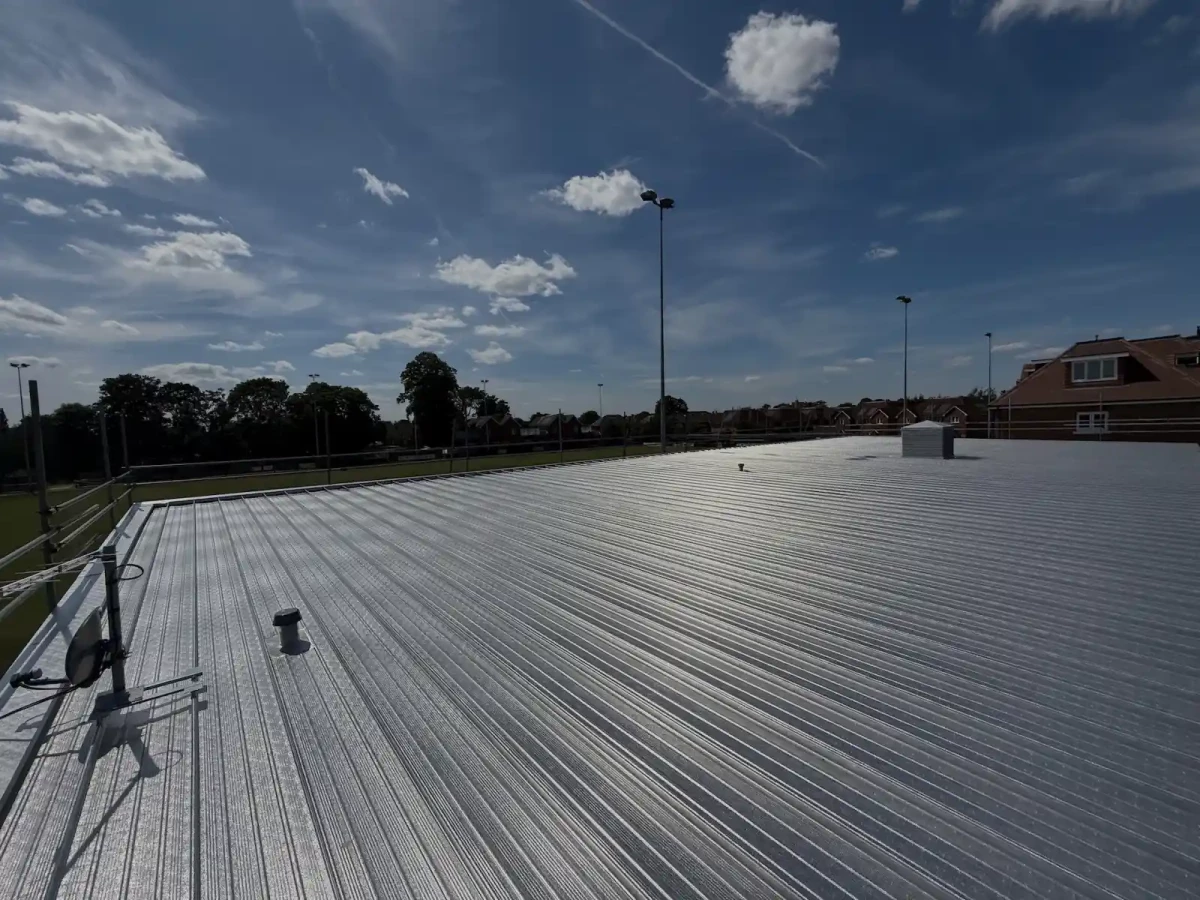
Standing seam systems — Kalzip, AshZip and similar — are among the most durable roofing systems available, with a design life of 40 years or more. Genuine failures on a properly installed standing seam roof are uncommon.
When issues do arise they are typically at flashing and detail junctions rather than in the standing seam panels themselves. Sealant failure at wall abutments, penetrations and ridge details accounts for the majority of standing seam roof leaks. These are almost always repairable without disturbing the main roof system.
If a standing seam roof is leaking, a condition survey and drone survey will identify the source quickly and accurately — and in the majority of cases, targeted repair rather than replacement will be the outcome.
The Repair vs Replacement Decision — A Practical Framework
Regardless of roof type, the decision comes down to three questions.
How many systems are failing? An isolated failure in one component points toward repair. Multiple simultaneous failures across gutters, fixings, rooflights and the roof surface itself points toward replacement.
What is the remaining serviceable life? Repairing a roof with 15 years of life left makes sense. Repairing a roof with 2 to 3 years left is money spent delaying the inevitable.
What is the total cost of repair vs replacement over 5 years? A repair that costs £8,000 today on a roof that will need two further repairs in the next five years may cost more in total than a replacement that carries a 20-year manufacturer guarantee.
A professional condition survey answers all three questions before you commit to either course of action.
Get a Condition Survey Before You Decide
Exall Group carries out condition surveys and drone surveys for commercial buildings across London, Essex, Hertfordshire, Surrey, Kent and the wider South East. We provide a full written report within 48 hours of survey — covering current condition, remaining serviceable life, and a clear recommendation on repair or replacement.
If your commercial roof is causing concern, the right first step is to understand exactly what you're dealing with. Call 0800 255 0325 or email info@exallgroup.com to arrange a survey.